
“Education is the most powerful weapon which you can use to change the world.”
Nelson Mandela.
I’m proud of my teaching. My journey as an educator has empowered me to identify effective learning approaches, developing skills that allow me to connect with students beyond basic coursework. My main objective as an educator is to inspire students to analyze issues and concepts, breaking them down to the smallest possible fragment. This method may seem abstract, but in fact it is very concrete. I learned this method of critical thinking from a class I took as part of my alma matter (FIU) university teaching accreditation: “The person who does the work does the learning.”
There are three main cornerstones that I apply in my classrooms to achieve my teaching goals. First, I create a learning friendly environment by providing relevant discussion topics to foment quality conversations regarding marketing and industry-relevant topics. Second, I challenge students to develop critical thinking, by breaking down their own suggestions and ideas of how to apply a particular marketing concept to an industry’s need. I invite students to discuss the feasibility, implementation, expected impact and possible side effects of their suggestions. Third, it is my personal belief that, as a professor, I am first and foremost a role model. When students can identify with their instructor, there is a greater likelihood of inspiration and consequently, learning. I am particularly mindful of students coming from underrepresented minority (URM) groups and first-generation college students. As a first- generation college graduate, I can deeply empathize with the “impostors’ syndrome” this population experiences when starting their university journey. By representing, respecting, and fostering diversity in the classroom, I empower all students to personally reach their highest level of learning and ultimately to be successful in their studies. Below, I detail some strategies that I use in my classrooms to achieve these three teaching objectives:
1.Create a learning friendly environment
When entering a classroom, my first task is to create a safe environment (judgment-free and excuse-free) where, instead of showing how much I know, I can facilitate students’ active learning through interaction and class discussions of real-world examples. Students then apply marketing concepts to industry relevant scenarios. To be successful, this learning experience needs to be founded on an atmosphere of respect for all students in the class. In Professor Torres’s classroom, we all (myself included) learn from each other regardless of cultural/academic background. Furthermore, it is my first commitment to consistently show my students that I genuinely care about them as individuals. I have seen how this approach empowers and enables students to flourish in their academic journeys. We all thrive in an environment where we feel that we belong and can freely express our thoughts and learn at our own pace.
2.Challenge students to develop critical thinking
I am a strong believer in a multi-method classroom approach. My classes involve a mixture of lecture, case discussion, video, and one of my favorite methods: games. I use interactive tools, such as Kahoot, to engage students while gauging their knowledge regarding what has been taught. Traditional lectures are necessary to introduce concepts and build a foundation. Upon this foundation, we (my students and I) build on with real-world case studies, viral marketing video analysis and other in-class group activities. I am particularly fond of in-class group activities because it gives an opportunity for the students to debate the class material amongst themselves, while I am available to clarify and facilitate the discussions. Lastly, I like to invite guest speakers to address relevant topics in which they are experts. This strategy enriches the classroom experience by providing students with a different perspective and feedback.
3.Be a role-model
As a professor, I understand my job is not limited to conveying knowledge. Our students look up to us to teach them valuable business skills, demonstrate workplace etiquette and respectful conflict resolution strategies, and ultimately how to portray themselves in the business world. As such, I try as often as possible to introduce two main projects for the semester: one group activity related to social marketing and one “marketing meeting” in which we analyze a real-word case. In the “marketing meeting” students take the perspective of a CMO, CEO and/ or CFO. We use the classroom as a boardroom, and we argue all perspectives of possible strategies the students present. This exercise is especially useful because it helps students develop self-confidence in their abilities to formulate and present business relevant ideas and strategies.
Teaching Accomplishments and future path
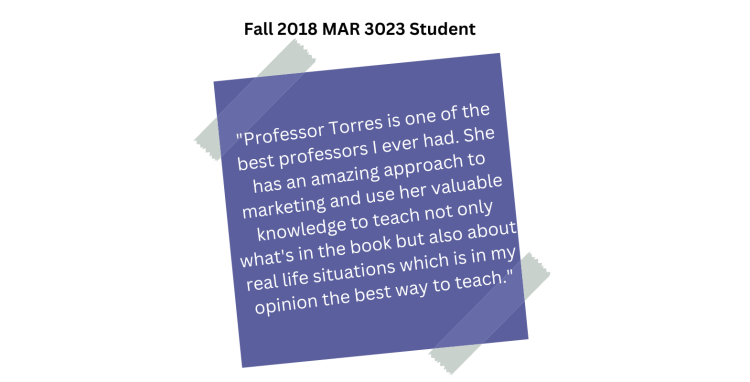
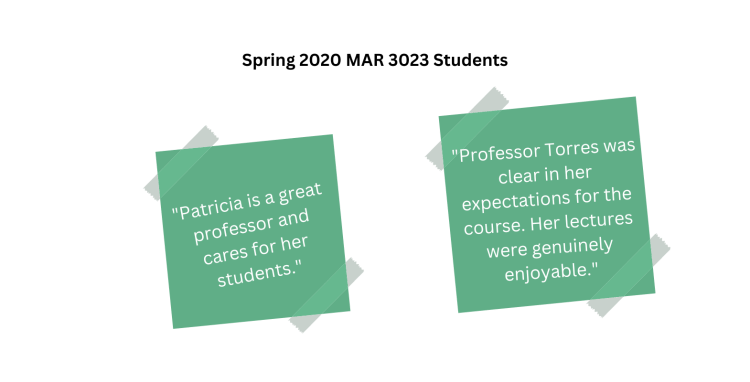
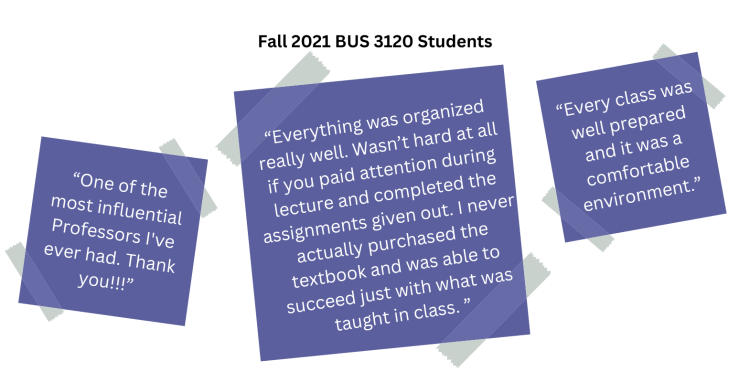
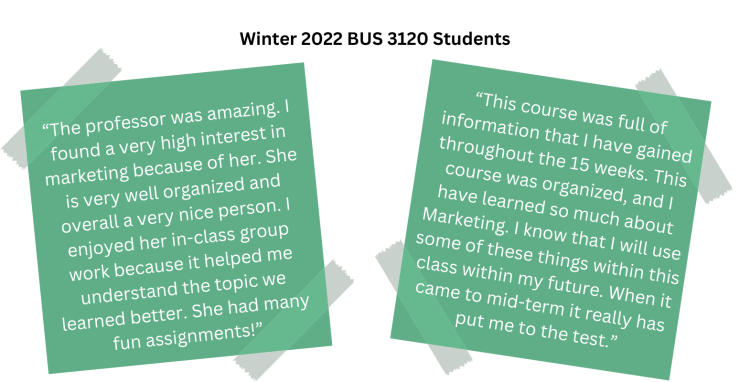
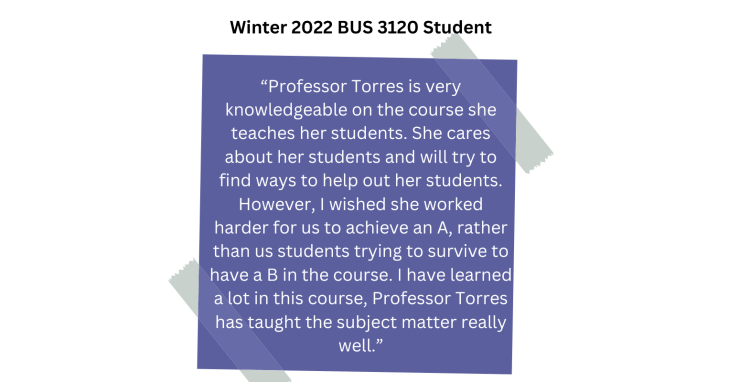
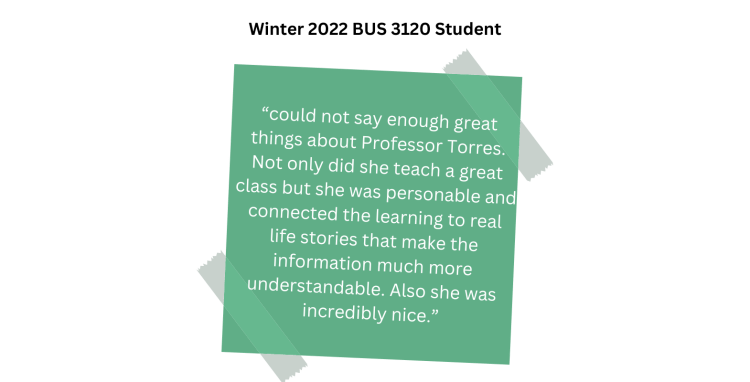
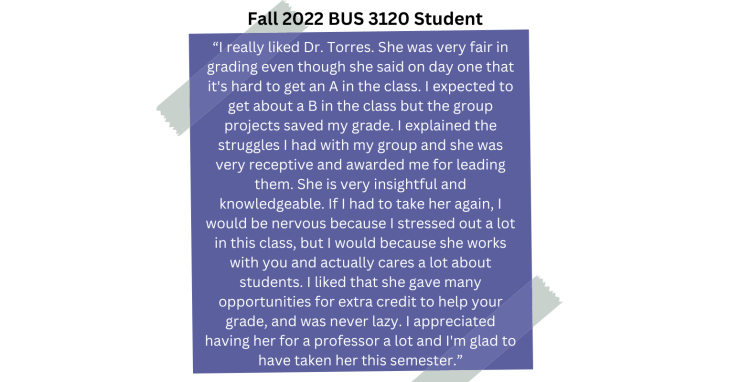
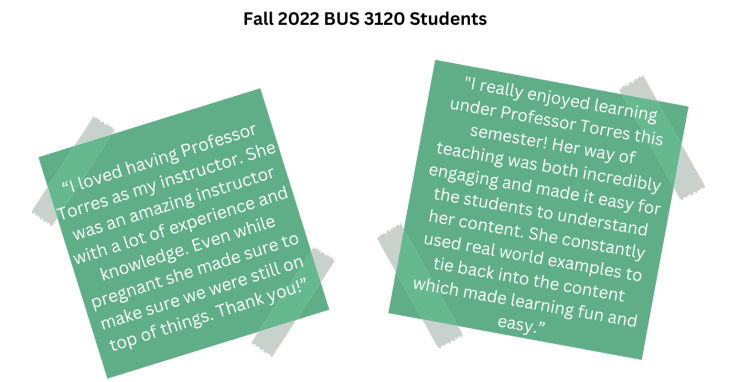
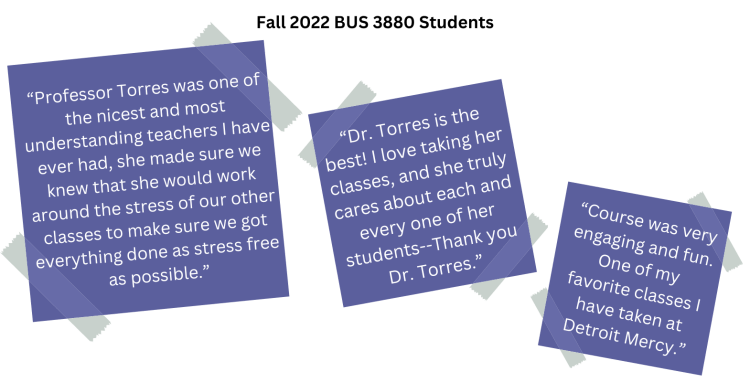
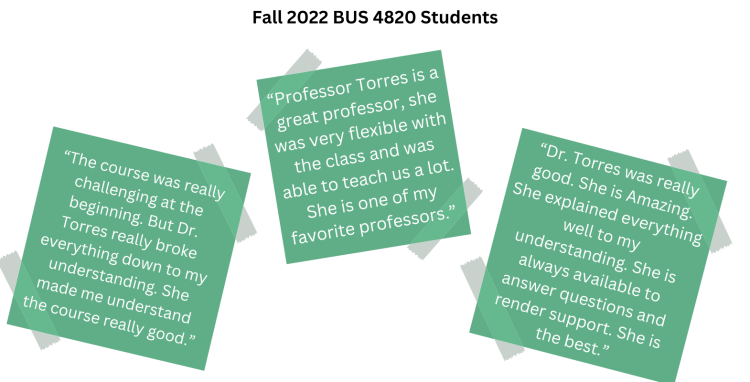
Fortunately, my journey as an instructor has been very rewarding so far. I have taught several marketing courses at University of Detroit Mercy and Florida International University: Introduction to Marketing (BUS 3120 /MAR 3023), Consumer Behavior (BUS 3820), Sports and Entertainment Marketing (BUS 3880), Channel and Retailing Management (BUS 4820) and International Marketing (MAR 4156) in classroom sizes that ranged between 15 to 150 students. During my PhD program, at FIU, I have been assistant in three other classes: Consumer Behavior (MAR 4503), Personal Selling (MAR 4400) and Advanced Consumer Behavior (MAR 6506). This experience has made me equally comfortable teaching small and large classes. My student evaluation ratings have been consistently among the highest in the department (average >4.5/5.0). I display some examples of these evaluations below. For further details on my teaching evaluations, feel free to contact me for a copy of my official teaching evaluations.
My corporate experience in banking and hospitality industries, my confidence to teach students from different backgrounds, and my teaching training and experience, both at University of Detroit Mercy and Florida International University (FIU, an institution that caters to minorities), have enabled me to develop strong teaching skills. I am confident I can successfully teach a range of marketing classes, from consumer behavior to sales and strategy classes. My passion for teaching and connecting with my students are powerful tools to advance knowledge and teach beyond the coursework.
 patriciatorrescb.com